War Books
The day I threw away my war memories—and found peace

When war broke out in Yugoslavia, I was a twenty-something rookie photojournalist living in Zagreb, Croatia—pretty much the administrative center of all the ensuing chaos. I had a front-row view of the war in all its ugliness. Plus, I already wielded a camera. It was only natural that I became a war photographer.
I must admit, shooting the war was addictive. Sometimes I’d wander into a melee or a gunfight and have to duck for cover. Other times, I was the target myself and, again, had to hit the dirt. Adrenaline junkies will understand this: every time I crawled out of a sticky situation unharmed, I was high on life. The feeling was so intoxicating that I started actively seeking out the excitement. A long lens wouldn’t do; it had to be a wide-angle, shot from up close.
At the start of the war, I was shooting for Večernji List, Croatia’s national newspaper. The paper often shared our photos for publication in books, posters, and brochures. As a result, I accumulated stacks of these publications featuring my work. When the war ended, I moved to Canada, bringing all those books across the ocean with me.
There were times in Canada when I thought I’d write down my war stories. My new Canadian friends and colleagues urged me to do it; to them, it was an exotic, unthinkable experience. At every war anecdote I shared, they exclaimed, “You must write that!” I figured the books I brought with me would be a good source to refresh my memory. In the end, I never did. There was a door inside me I never dared to open. Only now, writing here, am I learning to peek inside and reach into the darkness behind that door for a few memories, one fistful at a time.
The years passed. The news media changed, the internet took over, and newspapers collapsed. I lost my job. I freelanced, but felt no pull at my heartstrings for the work I had done for thirty years. It was time to hang up the camera once and for all. My wife and I decided to retire early and move back to Croatia to enjoy a slower, more affordable way of life by the sea. We packed a shipping container full of our belongings. Among the many things we would soon find completely useless over here, I shipped the books. I am a voracious reader, and even though I culled as many titles as my heart would let me before leaving Canada, there were still boxes of them in that container. And so, my war books ended up right back at their point of origin.
In Canada, I had found it challenging to explain what the war was about and what it felt like. Back in Croatia, I faced the opposite conundrum. Despite the country’s progress and the three new generations that had come of age since the fighting stopped, the war was still very much present in daily life—from everyday conversations to politics, right down to a persistent intolerance toward anyone deemed “not patriotic enough.” These were sentiments completely foreign to the man I am now. I had developed an aversion to the very idea of war and any notion of nationalism, and I had to finally admit to myself that I would never write my war story.
We currently live in a three-story house. That’s a lot of climbing up and down the stairs. At some point, probably in ten years or more, we’ll have to consider downsizing. Since we are currently doing some repairs on the place (there’s always something to fix on a house), we’ve been slowly clearing out the clutter we accumulated. Last week, we moved the bookshelves to paint the walls, which forced us to take a good, hard look at our collection.
There were computer manuals for systems that were scrapped for parts ages ago; software books for versions of Photoshop that don’t even exist anymore; and cookbooks—because really, who needs those when you can Google any recipe in seconds? There were fiction books I couldn’t part with when moving continents. And then, there were the war books.
The computer books were easy—chucked into the paper recycling bin without hesitation. The same happened to the cookbooks, save for a precious few we received from dear friends. Every fiction title faced the same question: “Would I ever read this again?” Most of them didn’t make the cut.
Then I looked at the last pile on the floor. The war books. They were memories packed in hardcovers, mementos of a life I once led and of a man I once was. When was the last time I had opened any of them? I couldn’t remember. Did I even want to be reminded of the years they represented? I didn’t think so.
I know what you might be thinking: if I am such a book lover, why didn’t I donate them to a library? I had put out the fiction titles to be taken. But the war books? Frankly, I don’t think they made for very interesting reading material for the general public. More importantly, those books had particles of my soul trapped between their pages. I may not have had the strength or desire to revisit them, but I knew I could liberate myself from the past if I finally let them go.
As we walked the dogs the next morning, the recycling truck came by and swallowed the bin containing the books. I watched it drive away and felt a sudden lightness. A heavy, dark part of my past was finally gone.
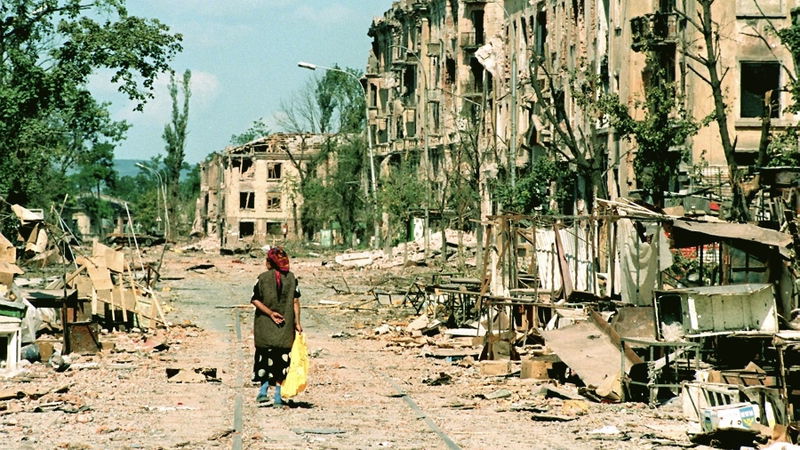
The photo shows an elderly woman walking through the downtown Grozny, Chechnya, looking for food or anything she can use. It was taken during the Chechens' war with Russia in the summer 1996.
Comments
No comments yet. Be the first to comment!