Aging Gracefully: Overcoming the Invisibility of Old Age
My newfound invisibility and mother’s passing turn bitterness of aging into everyday wonder.

Aging has been on my mind quite a bit lately. Not that I’m obsessing over it, but I can’t escape the fact that my face looks more and more like someone crumpled it up, changed their mind, and smoothed it back out, leaving all the creases behind. And the more my wrinkles show, the less attention I get from people—and that really bothers me. Where once I could chat up anyone, even random strangers, on pretty much any topic and make them laugh, now no one seems to listen. When I dare to start a conversation, people cut me off or simply turn away mid-sentence. It is as rude as it is hurtful.
The great Canadian wordsmith Margaret Atwood wrote in one of her short stories about how old people become invisible. No one looks at them twice, and no one cares what they—we—have to say. That is a painfully accurate description of how I’ve been feeling lately. Invisible. And it leaves me forlorn.
Browsing through the digital shelves of online libraries—my favourite pastime—I came across the book The Swedish Art of Aging Exuberantly by Margareta Magnusson. Oh, if I could only rediscover the exuberance of being alive, I thought, pressing the "download" button eagerly. It’s a lovely, short book full of anecdotes from the author’s rich, long life. Mrs. Magnusson rose to fame in her eighties with her previous book, The Gentle Art of Swedish Death Cleaning: How to Free Yourself and Your Family from a Lifetime of Clutter. It describes the practice of organizing and downsizing your home and belongings later in life so your loved ones aren't left with the overwhelming burden of sorting through everything after you’re gone. She mentions death-cleaning often, even in this new book. I wish I had read it—the death-cleaning book. Or better yet, I wish my mom had read it before she passed away.
Mom was 84 when she died. It was unexpected despite her age, at least for me and the rest of the family. She had been living at a retirement home for over a year when she was taken to the hospital with abdominal pain. It was 2021, the second year of the pandemic. Retirement homes across the country and the world had closed their doors to outside visitors in an effort to protect vulnerable elders from exposure to the deadly virus. Visiting relatives stayed on the lawn outside the building while their parents and grandparents looked on from the lobby through floor-to-ceiling windows. Like a modern version of a high-security prison, they talked on mobile phones while looking at each other through the glass.
My mom’s illness was diagnosed as an inflammation of the pancreas that had spread to her liver. Surgery was urgently needed to remove the malfunctioning parts of the organs, the doctors informed me over the phone. In a follow-up call, they told me the surgery had been successful, but unfortunately, Mom never woke up. I kid you not—those are the exact words they used.
I hadn’t seen my mom for over a year before that. We kept in touch over the phone and WhatsApp, but problems with her pancreas and liver had never come up. Actually, neither I nor she even knew anything was wrong with them. Nor did we fully grasp the potential dangers of her surgery.
The retirement home’s administration, full of "compassion," gave me 48 hours from her passing to empty her room, even though it was the beginning of July and the rent had been paid through the end of the month. They had a long waiting list, they said, appealing to my understanding while showing none of their own. To make things even more "interesting," they warned me against bringing anyone to help me because of COVID protocols. Thinking about it now, I’m not sure if the book on death-cleaning would have actually done any good, even if I'd known about it and given it to her. Not long before COVID, she had moved from a two-bedroom apartment to a single room in the retirement home, into which she somehow managed to cram almost as much stuff as she had owned in her much larger former flat. That was how I found myself standing in my mom’s room—absent of her, yet filled to bursting with her things. It took some tears and a massive amount of physical and mental strength to deal with the clutter. I wish she'd had the foresight to reduce some of it, sparing me at least some of the pain and frustration. So, yes—I can appreciate the concept of death-cleaning from firsthand experience.
Going methodically through the room, I found an alarming amount of grappa in plastic bottles stashed everywhere. There were bottles of the stuff hidden among the cleaning detergents and shampoos under the bathroom sink, a couple of "legitimate" ones in her mini-fridge, one in the umbrella stand, two wrapped in paper among her shoes, and a few tucked here and there between the books on her shelves. Of course, it made me wonder what had been going on.
In her working life, my mom had been a math and physics teacher, accustomed to lecturing others and commanding attention when she spoke. That is why it’s perhaps not so surprising that she reached for alcohol to help her cope with the irrelevance she experienced as she coasted through her golden years. After the funeral, her neighbours and friends from the home told me that she had actually been using brandy as medicine to deal with her invisibility. She became very prolific at it—she had become an alcoholic.
As I face my own invisibility, I hoped the book about aging exuberantly could teach me how to turn it into a superpower. What I learned—what I am learning—is that finding exuberance, or even just plain old happiness, consists of many small steps and a massive shift in attitude.
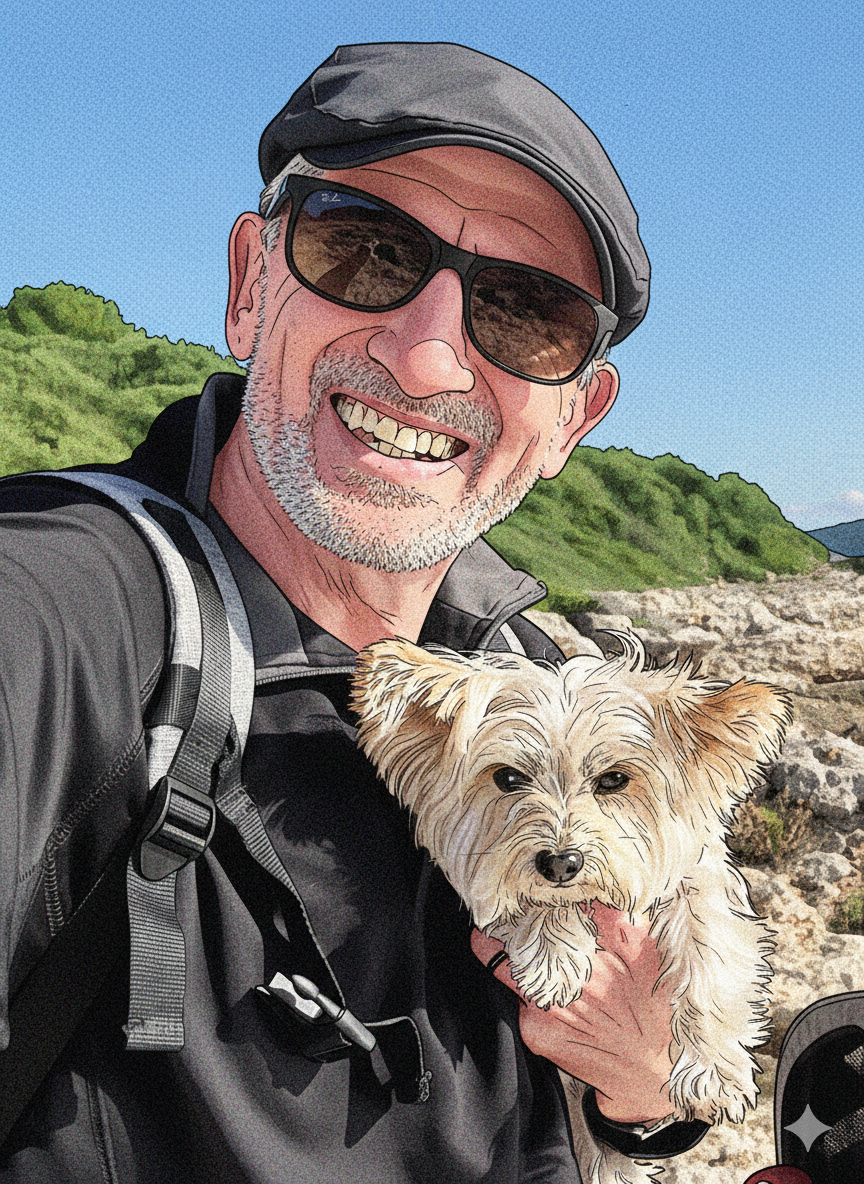
In short, I am finding happiness in common, everyday things: from morning dog walks with my wife and our two furry babies, to simple chores around the house, to occasional trips into nature and the many amazing places we still wish to see. Bonus happiness points go to evenings spent playing the piano to an audience of one (not counting the dogs), accompanied by a glass of red wine.
As for that big attitude change I mentioned—I admit that over time, I had become the kind of old fart who never fails to point out how things were better when I was young; how we respected our elders, how people were nicer to each other, and how today’s youth aren’t made of the same firm stuff we were. Of course, it’s all bullshit. It’s exactly the same crap my father and grandfather said about my generation.
In her book, Mrs. Magnusson implores us to look around, see the beauty of the world we live in, embrace it, and enjoy it. That made me realize that many people in my generation stew in the stale juices of the past until we become bitter and find something to dislike in everything. With a lifetime of experience, it’s easy to find faults. The trick is to turn that on its head and look for the good.
Now, when I realize I’m sinking into the cesspit of aging bitterness, it helps to tell myself: We had our chance to change things, and look at the mess we made! Now it’s the next generation’s turn. Step aside and let them try to fix what we fucked up.
It’s a humbling thought that I now live in the next generation’s world. And a very liberating one, to think that I should leave the problems for someone else to fix. It makes it so much easier to let go of resentment and focus on the things that make life nicer, easier, and more enjoyable—smartphones, smart cars, and smart solutions in smart cities full of, hopefully, smart people. I don’t even need to look hard to see that for every thing that annoys me, I can find many that thrill me.
Take traffic, for example. Yes, it’s gotten worse, busier, and more crowded. But the roads are getting better all the time—wider, smoother, nicer. Cars are more comfortable, practical, and efficient, regardless of whatever energy propels them. Public transit is improving; buses, trams, and trains are reliable, fast, and comfortable. Getting lost is almost impossible with a GPS guide inside every mobile phone. The same goes for almost every other sphere of life. One only needs to retrain one's senses to see the positive surrounding us.
And that’s where I’m at: trying to find two good things for every bad one I perceive. Magically, that attitude brings wonder right back into living. It makes aging a journey filled with wonder, beauty, and grace.
Comments
No comments yet. Be the first to comment!